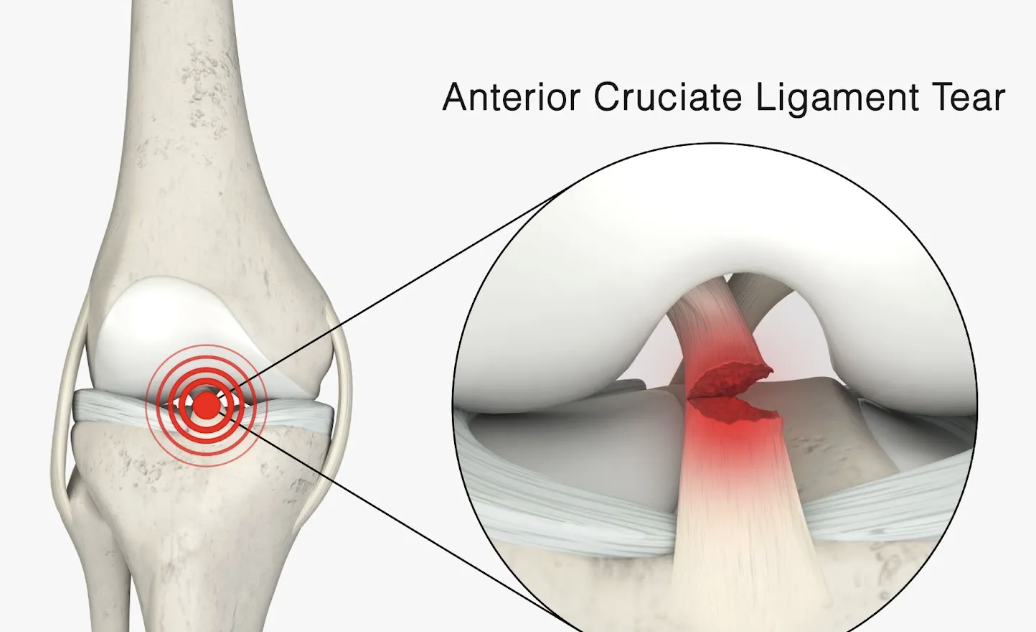
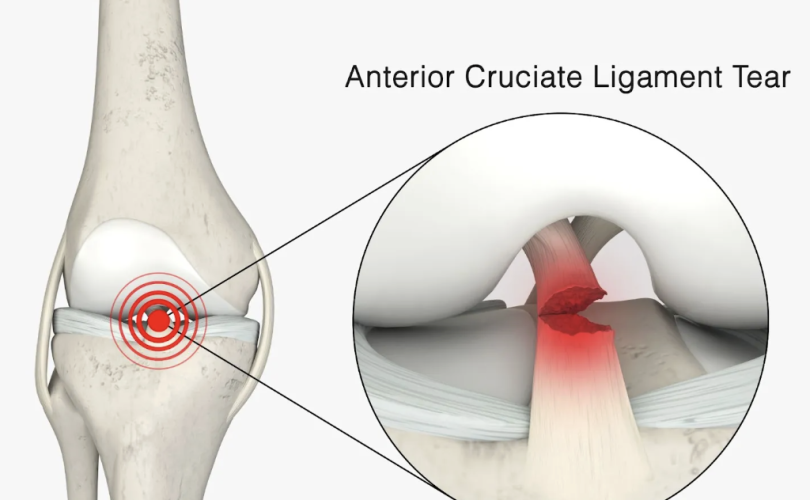
If you’ve recently injured your knee or have been told you have an ACL tear, you’re not alone. ACL injuries are among the most common knee injuries seen in sport. Understanding what the ACL does, how injuries occur, and what recovery involves can help you feel more confident throughout your rehabilitation journey.
What is the ACL?
The Anterior Cruciate Ligament (ACL) is one of the major stabilising ligaments of the knee. It connects the thigh bone (femur) to the shin bone (tibia) and plays a critical role in controlling knee movement during activities such as running, jumping, changing direction, and landing.
ACL Anatomy
The ACL is located within the knee joint and runs diagonally between the tibia and femur.
Origin: The ACL attaches to the tibia immediately in front and slightly to the outside of the anterior tibial spine.
Insertion: It attaches to the posterior part of the medial surface of the lateral femoral condyle.
The ligament consists of two functional bundles:
- Anteromedial bundle
- Posterolateral bundle
These bundles work together throughout knee movement to provide stability across the entire range of motion.
Microscopic Structure
The ACL is primarily composed of strong collagen fibres, with approximately 10% elastic fibres. This composition gives the ligament excellent tensile strength while allowing a small amount of flexibility.
What Does the ACL Do?
The ACL acts as one of the knee’s primary stabilisers.
Its main functions include:
- Preventing the tibia from sliding forward relative to the femur.
- Controlling rotational movements of the knee.
- Assisting with side-to-side stability.
Research shows the ACL provides:
- Approximately 86% of the restraint to anterior (forward) displacement of the tibia.
- Approximately 30% of the resistance to medial displacement of the tibia.
Because some portion of the ligament remains under tension throughout the entire range of knee movement, the ACL contributes to knee stability in almost every position.
How Do ACL Injuries Happen?
ACL injuries can occur through either non-contact or contact mechanisms.
Non-Contact Injuries (Most Common)
Most ACL injuries occur without direct contact. Common scenarios include:
- Sudden changes of direction (cutting or pivoting)
- Landing awkwardly from a jump
- Rapid deceleration while running
Sports such as AFL, netball, basketball, rugby, skiing, and soccer commonly involve these movements.
Contact Injuries (Less Common)
Direct contact to the knee or body can also result in an ACL injury, including:
- A tackle during sport
- A collision with another player
- A fall causing excessive twisting forces through the knee
Do All ACL Tears Need Surgery?
Not necessarily.
The decision to undergo ACL reconstruction depends on several factors, including:
- Age and activity level
- Sporting goals
- Occupational demands
- Knee stability
- Associated injuries (such as meniscus or cartilage damage)
Many people benefit from a period of physiotherapy before deciding whether surgery is the right option.
ACL Reconstruction Surgery
When surgery is recommended, the torn ACL is replaced using a graft.
Autograft
An autograft uses tissue from your own body.
Common options include:
- Patellar Tendon Graft
- Hamstring Tendon Graft
- Quadriceps Tendon Graft
Allograft
An allograft uses donor tissue from another individual of the same species.
What is Lateral Extra-Articular Tenodesis (LEAT)?
Some patients may undergo a procedure called Lateral Extra-Articular Tenodesis (LEAT) alongside ACL reconstruction.
LEAT is designed to improve rotational stability of the knee, particularly in patients at higher risk of re-injury.
The procedure:
- Re-routing a strip of the iliotibial band under the lateral collateral ligament, to create a restraint to tibial internal rotation
LEAT may be considered for:
- High-level athletes
- Revision ACL surgery
- Individuals with significant rotational instability
ACL Recovery: What to Expect
Recovery from ACL reconstruction is a long-term process that requires commitment, consistency, and guided rehabilitation. Current best practice follows a criteria-based progression rather than a strict timeline. Most individuals return to change of direction sport at 9-12 months post-op if they have met the appropriate criteria.
The ACL Melbourne 2.0 Protocol
The ACL Melbourne 2.0 Protocol is a widely recognised criteria-based rehabilitation framework that outlines progression through each stage of recovery.
Pre-Operative Phase
Goals:
- Eliminate swelling
- Regain full range of motion
- Regain 90% strength in the quads and hamstring compared with the other side
Phase One: Recovery from Surgery
Goals:
- Get the knee straight
- Settle the swelling down to ‘mild’
- Get the quadriceps firing again
Phase Two: Strength and Neuromuscular Control
Goals:
- Regain most of your single leg balance
- Regain most of your muscle strength
- Single leg squat with good technique and alignment
Phase Three: Running, Agility and Landing
Goals:
- Attain excellent hopping performance (technique, distances, & endurance)
- Progress successfully through an agility program and modified game play
- Regain full strength and balance
Phase Four: Return to Sport
Goals:
- Build confidence in sporting movements
- Gradually return to training and competition
Phase Five: Prevention of Re-Injury
Goals:
- Maintain strength and conditioning
- Continue neuromuscular training
- Reduce future injury risk
Research continues to show that ongoing strength and movement training remains important long after returning to sport.
How Physiotherapy Can Help
Physiotherapy plays a vital role throughout every stage of ACL management, whether you choose surgical or non-surgical treatment.
Your physiotherapist can help you:
- Understand your injury
- Reduce pain and swelling
- Restore movement and strength
- Improve balance and coordination
- Progress safely through rehabilitation
- Return to work, exercise, and sport with confidence
Final Thoughts
An ACL injury can feel overwhelming, but with the right guidance and rehabilitation plan, most people can successfully return to the activities they enjoy. Early assessment, appropriate treatment, and a structured rehabilitation program are key to achieving the best possible outcome.
If you’ve recently injured your knee or would like advice about ACL rehabilitation, our physiotherapy team is here to help guide you through every stage of recovery.
Written by Ellie, Physiotherapist at Prime Physiotherapy