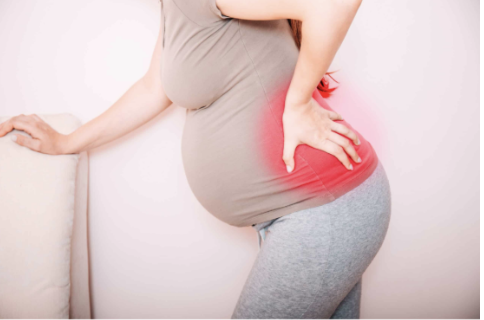
One of the most common complaints during pregnancy is low back pain, with or without associated hip, pelvic, or sciatic pain.
Statistically, up to 50% of pregnant women experience lumbo-pelvic pain at some stage of pregnancy. A significant number of women are able to self-manage their symptoms by modifying lifestyle factors, resting, and using heat. However, others require professional support. As with many health issues, prevention is preferable, and some effective strategies to prevent or minimise lumbo-pelvic pain include maintaining a strong core, pelvic floor, and leg musculature, as well as staying physically active.
Previous blogs have explored core strength, pelvic floor function, and general fitness during pregnancy in more detail. This article focuses specifically on pain management.
Conditions Included in Lumbo-Pelvic Pain
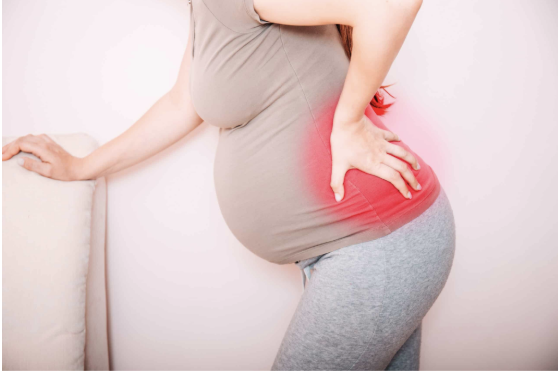
Lumbo-pelvic pain is an umbrella term that can include a range of musculoskeletal conditions, such as:
- Lumbar spine muscle pain
- Disc prolapse
- Sciatic nerve compression
- Sacro-iliac joint pain
- Gluteus medius overactivity
- Piriformis overactivity
- Pubic symphysis pain
- Adductor muscle pain
- Hip pain, with or without iliotibial band involvement
- Trochanteric bursitis
Assessment and Management
Analysing the cause of lumbo-pelvic pain can be complex. A musculoskeletal women’s health or pelvic floor physiotherapist has the specialised skills required to assess these conditions accurately. A thorough lumbo-pelvic assessment is essential to guide appropriate treatment.
General Advice for Managing Lumbo-Pelvic Pain in Pregnancy
Some general strategies that may help manage lumbo-pelvic pain include:
- Maintaining strong muscle support, including the pelvic floor, abdominal, gluteal, and hip muscles
- Postural awareness, such as standing with weight evenly distributed through both feet, bending the knees when lifting, and using pillow support during sleep to minimise twisting
- Pain relief strategies, including the use of a massage ball or roller (where positions allow), local heat, and medication as advised by your treating doctor
- External support, such as a sacro-iliac joint belt, Tubigrip, SRC, or other supportive garments
- Minimising lifting and carrying heavy loads
- Resting when possible
- Performing stretches as prescribed by your physiotherapist
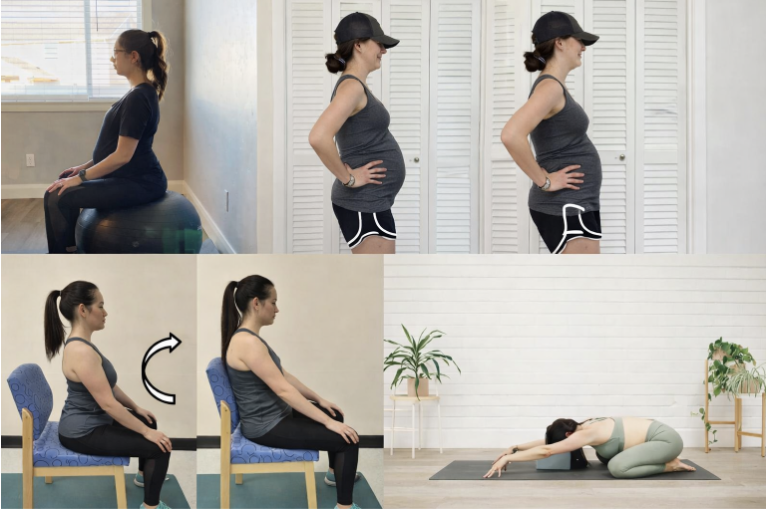
One of the most commonly relieving exercises is the pelvic tilt, which can be performed in several positions, including sitting, standing, on a ball, leaning forward on a bench, or in a modified child’s pose.
Upper Back and Other Joint Pain
Thoracic or upper back pain may also develop during pregnancy, particularly as breast size increases. This can often be improved with a well-fitted, supportive bra. Attention to posture, upper back strengthening, and pain-relieving techniques may also be helpful.
Increased ligament laxity during pregnancy reduces joint support and can affect other joints throughout the body, including the wrists, base of the thumbs, and knees.
The principles of managing these symptoms include:
- Support: improved muscle strength and/or the use of braces or supports
- Activity modification: attention to posture and incorporating rest
- Pain relief: heat, massage, and medication as advised
If symptoms do not improve with this general advice, an assessment with a musculoskeletal women’s health physiotherapist is recommended.
Reference
Salari, N., et al. (2023). The global prevalence of low back pain in pregnancy: A systematic review and meta-analysis. Journal of Pain Research. https://www.ncbi.nlm.nih.gov/pmc/articles/PMC10693090/
This systematic review shows that back and pelvic pain are highly prevalent during pregnancy, highlighting the commonality of musculoskeletal pain in this population. (PMC)
Santos, F. F., et al. (2023). Prevention of low back and pelvic girdle pain during pregnancy: A systematic review and meta-analysis. PubMed. https://pubmed.ncbi.nlm.nih.gov/36288631/
This meta-analysis provides evidence that exercise is an acceptable and promising strategy for preventing episodes of low back and pelvic girdle pain during pregnancy, supporting the exercise and activity recommendations in your blog. (PubMed)
Written by Cathy Cox, Head of Women’s Health Physiotherapy, Prime Physiotherapy
Edited by Li Zhou, Women’s Health Physiotherapist, Prime Physiotherapy & Valeria Vallejos, Remedial Massage Therapist, Prime Physiotherapy